What 100+ major projects across 13 countries
have taught us about local stakeholder risk.
A BUILDING PERMIT IS NOT THE SAME AS PERMISSION
A project can be technically and financially viable, fit
within planning and regulatory frameworks and align with
national priorities and still be delayed or stopped by local
opposition. Major developments enter communities with
established livelihoods, political relationships, institutions
and expectations of their own future.
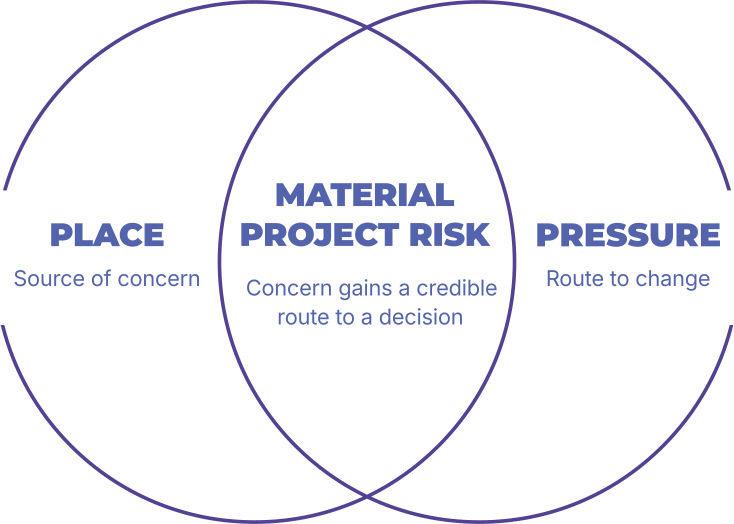
Project leaders therefore need two forms of diagnosis.
Place explains why a concern exists: what people expect
the project to change, who they believe will gain or lose,
which decisions they can influence and whom they trust.
Power explains whether that concern can affect the
project: who can organize around it, who can lend it
credibility and which political, regulatory, financial or
media decision it can reach.
PLACE CREATES THE CONCERN. POWER DETERMINES WHETHER IT CAN HAVE PROJECT IMPACT
- Site, scale, route and physical effects
- Distribution of benefits and burdens
- Influence over decisions that remain open
- Trust, history and institutional conduct
- Mobilisation by residents, businesses or NGOs
- Validation by experts, media or political actors
- Pressure on permits, politics, finance or courts
- Impact on route, timetable, investment or licence
CONCERN BECOMES PROJECT RISK THROUGH A FIVE-STAGE ESCALATION PATHWAY.
1
concern
A local impact, uncertainty or perceived unfairness emerges.
2
MOBILISATION
Residents, businesses, NGOs or local groups organise.
3
VALIDATION
Experts, institutions, media or politicians give the issue credibility.
4
POLITICAL PRESSURE
The issue enters politics, regulation, media, courts or finance.
5
PROJECT IMPACT
A permit, route, timetable, investment case or commitment changes.
KEY OBSERVATION:
The most visible issue is not always the decisive one. Public meetings and social media reveal intensity. They do not, on their own, show which concern can change key parts of the project.
THE PERMISSION TO BUILD FRAMEWORK
- Read the place
- Map the power
- Trace the pathway
- Protect real choice
- Change what matters
LEARN MORE ABOUT HOW TO:
- Establish what the project means locally.
- Distinguish formal authority from informal influence.
- For each concern, describe how it could move
- Engagement has strategic value when it can still affect design
- Match the response to the diagnosis
CLICK HERE TO DOWNLOAD
THE FULL WHITE PAPER